
 Back
Back
Why we built AEO Analytics?
 AEO Analytics
Search used to be easier to explain.
For years, most organic growth teams knew where to look. Google was the center of the map. Rankings, keywords, backlinks, technical health, and content quality were the common language. Those things still matter, but the search experience around them has changed. People now discover brands through AI-generated answers, conversational interfaces, AI Overviews, community platforms, social search, and recommendation layers that do not behave like the old results page.
The Visibility Problem Has Changed
That shift created a new kind of visibility problem.
- A company can rank well and still be absent when a buyer asks an AI system for recommendations.
- A brand can have strong content and still lose the answer to a competitor that is cited more often, described more clearly, or better represented across trusted sources.
- A team can invest in SEO and still struggle to understand whether it is visible in ChatGPT, Gemini, Claude, Perplexity, Google AI experiences, or the next interface buyers adopt.
This is why we built AEO Analytics.
Why We Built It
AEO Analytics exists because the market around AI search is moving faster than most teams can evaluate it. Every week, there are new terms, new tools, new agency claims, new reports, and new advice about AEO, GEO, LLM visibility, AI search optimization, and answer-engine performance. Some of it is useful. Much of it is repetitive. A lot of it is difficult to compare.
The problem is not that teams need to be convinced AI search matters. Most already understand that discovery is changing. The harder question is more practical: where should they start, who should they trust, and what should they use to make better decisions?
AEO Analytics is built as a practical map for teams trying to understand the AI search ecosystem without getting lost in vendor noise, inflated claims, or disconnected advice.
How the Site Is Organized
The site is organized around three simple entry points.
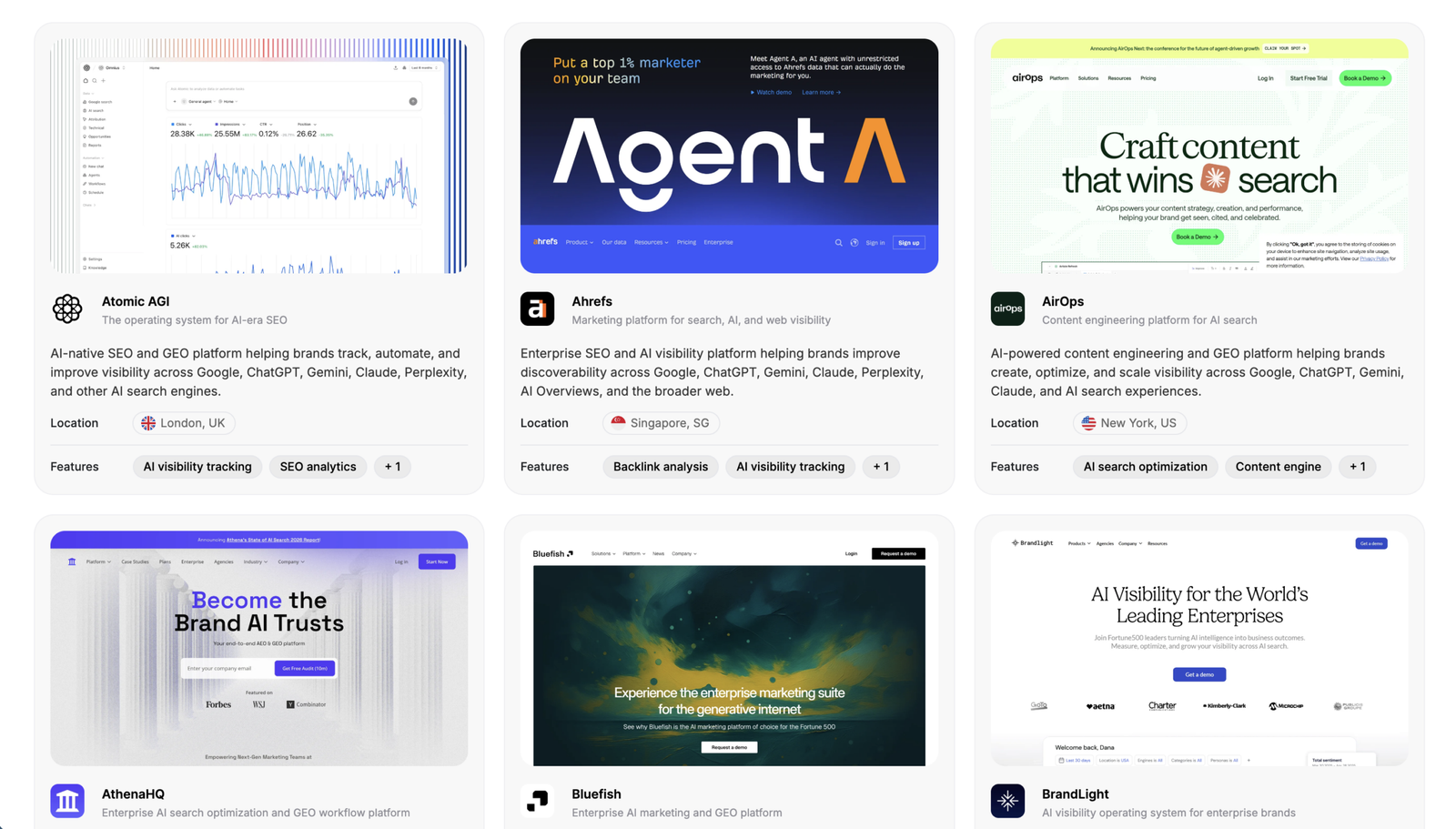
- Teams comparing software can start with the AEO Tools directory.
- Teams looking for outside expertise can explore the AEO Agencies directory.
- Teams still building their internal point of view can read through the AEO Resources library.
Those pages are not meant to replace judgment. They are meant to make judgment easier.
Evaluating a Young Category
AEO is still a young category, and that makes evaluation difficult. Traditional SEO tools were built around relatively familiar metrics: rankings, search volume, backlinks, technical issues, and traffic. AI search introduces a different set of questions. Is the brand mentioned in generated answers? Is it cited as a source? Which prompts trigger inclusion? Which competitors appear instead? Which pages, publishers, or third-party sources shape the answer? How should a team connect AI visibility back to content, technical SEO, digital PR, brand authority, and revenue?
Those are not theoretical questions anymore. They affect how buyers discover products, compare options, and decide which brands deserve attention. AEO Analytics was built for the moment when teams move from “AI search is interesting” to “we need to understand our position in it.”
It was also built because the category needs more structure. Right now, AEO can mean several things depending on who is using the term. For some teams, it means tracking brand visibility in AI answers. For others, it means:
- improving citation likelihood
- restructuring content
- strengthening entity signals
- auditing technical crawlability
- building topical authority
- understanding AI referral traffic
In practice, it is usually a combination of all of those things.
That is why AEO Analytics does not treat the space as one narrow software category or one narrow agency service. The point is to help teams see the ecosystem clearly enough to make the next right move. Sometimes that move is testing a tool. Sometimes it is hiring a specialist. Sometimes it is reading enough research to avoid buying anything too early.
AI Search Is Now Cross-Functional
There is another reason we built it: AI search has made organic growth more cross-functional. SEO teams can no longer look only at rankings. Content teams can no longer look only at traffic. Brand teams can no longer assume that reputation lives only in owned channels. Analytics teams need to separate traditional organic performance from AI-assisted discovery. Leadership teams need a way to understand why visibility can increase or decrease even when the old dashboards look incomplete.
AEO Analytics is meant to sit at that intersection.
Who AEO Analytics Is For
- It is for the SEO lead who needs a clearer way to evaluate AI visibility.
- It is for the SaaS marketer trying to understand why competitors appear in AI-generated recommendations.
- It is for the founder who knows the category is important but does not yet know whether to buy software, hire help, or build internal knowledge first.
- It is for the content team that wants to adapt to AI search without abandoning the fundamentals that made SEO work in the first place.
Our Point of View on SEO
That last point matters. We do not believe AEO replaces SEO. We believe SEO is expanding. Technical accessibility, content depth, topical authority, structured information, source credibility, and brand trust still matter. The difference is that the information now has to be legible not only to search engines and readers, but also to AI systems that retrieve, summarize, compare, and recommend.
AEO Analytics was built to help teams adapt to that broader reality.
What Comes Next
The first version is intentionally focused. The goal is not to create the largest possible database or publish every company that uses AI search language. The goal is to make the space easier to navigate. As the market matures, AEO Analytics will continue to evolve with it: more useful comparisons, better resources, clearer category definitions, and a stronger view of what actually helps brands become visible in AI-driven discovery.
The launch message is simple. Search has fragmented. AI answers are becoming part of how buyers learn. The old map is no longer enough.
AEO Analytics is the new starting point for understanding who, what, and how to evaluate in AI search.
Explore it here: aeoanalytics.ai .